Last spring a friend suggested that the public needed to better understand environmental health and industrial hygiene. “Y” felt others would be interested in its relevance to daily life and living, and I would be the perfect person to write about it. I liked the idea, but was busy with job decisions, a book release and grandmothering. I too questioned whether I needed yet another (unpaid) writing project! Then, this week a different friend asked me to explain in simple terms what it is to be an industrial hygienist. This question came after I shared a photo of me in Seattle discussing my recent book. Yes, the ten of us in the photo are officially industrial hygienists, many I first met in graduate school 40 years ago, and all I’ve developed friendships with during our careers. I have often said how grateful I am to have chosen this career; and how fortuitous my path into and through it has been.

As if that wasn’t enough of an invitation, last week while pushing my grandson in a swing in a local Portland park I chatted with a fellow “swing pusher” and yes, my profession came up. (No, I didn’t make this up and yes I can talk a lot, just ask my spouse or daughters. To be fair, I can find connection in most anything.) The person thought it sounded cool! (Yes, she did say cool.) And you know what, our profession is cool! Even if few recognize the title or understand what it means. The pandemic helped a bit in elevating our profession with others, but not as much as one might have expected. Many folks didn’t understand there were actually professionals trained to make decisions about respirators, infectious disease control and the like: and, not all decision makers asked us our opinions. (See: Industrial hygiene from science to the art of winging it.)
In my earliest career years I made a joke when describing our profession by saying we didn’t do this or that (teeth or toilets). A decade later I felt that might be construed as demeaning to other professions when that wasn’t what I meant, so I instead changed up my typical response. One of my best friends who I had the great joy of working with for over a decade is on her path to publishing a memoir. I’m excited for her and I love sharing our post career lives as writers. I also know she and I – unlike other traditional writers – share both side humor and crazy memories true to our experiences as industrial hygienists.
Yesterday I reviewed my blog statistics. I found more than five dozen people over the last few years have clicked on my link defining industrial hygiene (shared as a comment to a nudge from this same writer friend on my “About” page). That’s something! Of course the unfamiliarity is no surprise. Kids don’t grow up saying “I want to be an industrial hygienist” like they do about wanting to be nurses, doctors, lawyers and teachers. Somebody long ago might have done better with the title, no doubt.
Industrial hygiene, sometimes called occupational hygiene in other parts of the world, is defined as the science of identifying, evaluating, and controlling workplace conditions that can cause injury, illness, or other health and safety issues. Today I think the “industrial” part of our title confuses some. Yes, it makes more sense when we think back to how hazardous many jobs were during the industrial revolution. Jobs were dirty: yes, some still are. (Watch this video: Workplace Health and Safety, to the 1920s if you want to know more.) Imagine working in a smelter or foundry laden with dust and particles containing metals – lead, cadmium, chromium, arsenic. Dust on clothing that might be taken home; inhaled at work or at home, or ingested with lunch in a still contaminated space. Most folks today understand the risks of breathing asbestos and lead. Many people might also harken back to stories or movies about other exposures: radiation, excessive noise, or exposures to the community from industrial sources like Love Canal or the vermiculate mine in Libby Montana. And yes, industrial hygienists also evaluate the stressors of work on our bodies – the way they can ache and be damaged because of repetitive tasks and activities demanding us to do too much for too long. Importantly, we understand how to design better jobs.
Most industrial hygienists are also expected to understand traditional safety: trenching and shoring, fall protection, working surfaces, and such, with some though not all adding the Certified Safety Professional credential. Today we also pay attention to the impact of psychological, emotional and psychosocial stressors. Add to all of this compassion, empathy, advocacy, good communication skills, maybe an extra language or two: perfect! And often very challenging.
Folks serious about a career in industrial hygiene work toward certification and can proudly call themselves Certified Industrial Hygienists, or CIH. Some, I’m close to joining this club, may go on to add CIH-Retirement (CIH-r) for retired. At this point in time, there are as few as 6,849 active CIHs worldwide: it’s no surprise folks don’t better know about us. I remember once estimating we had 50-60 CIHs in Oregon, though it was merely a guess.
Promotion: do you know someone looking for a cool new career? Check this out. Seriously. We need you! The field needs you. Workplaces need you.
One thing industrial hygienists have in common, is having experienced at least one unusual (or hazardous or weird) industrial hygiene job or project. Yes, get a group of us together and, oh my, the stories we tell. (We do talk about other things too, mind you.) While more mundane tasks also dot our careers, these outliers are good stories and do illustrate the range of what we work on. Yes, I can share stories like the rest – the six meter wide pool of mercury we spotted on the ground during the Bunker Hill Superfund Cleanup, or the wild road trip while providing health and safety support to EPA Criminal Enforcement investigators. Instead, I decided here to share this hair product (yes, hair) example to illustrate how we work to identify + evaluate + control + communicate about exposures in the workplace. This work was both unusual and high profile: the only time I’ve been quoted in media from hair blogs and Cosmopolitan to NPR and the LA Times.

Even though this story began 14 years ago, it reminds us that sometimes we can make a difference which is why many stick with this career. It’s also a story about beauty at all costs, the power of the dollar, the importance of reducing hazardous chemicals and the risk of ignoring worker voice. I began thinking about all this after the recent nomination of Kamala Harris for president. After all, her office of California Attorney General was the primary means for bringing truth, honesty and demand for safe usage of a product many hair stylists had been told was not toxic.
Yes, this work identified and evaluated a hazardous and OSHA regulated chemical that most stylists then didn’t understand. (Hint: methylene glycol is the chemical name for the hydrated form of formaldehyde, producing formaldehyde when heated. Think embalming fluid.) The treatment was an expensive process in which stylists would comb the liquid formula through freshly shampooed hair, and then both blow dry and flatiron to “seal it in place”, thus alleviating the need to flatiron each morning, for those who liked the look of smooth hair. (There is a famous actress who, back then, some folks would liken the finished hair to ….)

What do I remember? Those first weeks when I began hearing from stylists around the country that they had been told the product was safe, non-toxic, and formaldehyde-free – but were experiencing asthma like breathing conditions, bloody noses, and other mucous membrane irritation. We knew we didn’t yet have enough data to put out warnings as science had to lead our work and I am grateful still for the knowledgable analytical chemists jumping into this investigation once I began collaborating with Oregon OSHA. Then we started warning others. Federal OSHA jumped in too and reminded stylists and salon owners that the concentration of the chemical in this product was regulated by a fairly detailed standard requiring sharing of (Material) Safety Data Sheets, training, effective ventilation or respirators, air monitoring…..you get the point. Not something most salons – any salons? – were prepared or interested in doing.
The point here is that the knowledge we industrial hygienists have can be relevant to most jobs and industries where folks work. And yes, back then we were attacked, especially on social media, and not long after by a frivolous law suit (eventually dropped) by the product manufacturer toward both my employer (OHSU) and Oregon OSHA. I had more sleepless nights that year than even during pregnancy or when raising kids, especially in the early days when we couldn’t yet share what we believed to be true. However, the thanks I received over time from stylists who had been lied to because of the “power of beauty” and commercial selling potential confirmed for me how important this work was.
I share this story – albeit long-winded – as a premier example of how each industrial hygienist likely has had experiences beyond what they ever imagined, and sometimes in workplaces many of us don’t think of as being classically hazardous. Yet, they exist. As do the known hazardous jobs. We each too have many examples where people still got hurt, developed work-related chronic diseases. That makes those success stories even more fulfilling. So, what does an industrial hygienist do? In simple terms: we work to identify + evaluate + control + communicate about exposures in the workplace
And….my industrial hygiene friends: how about Part 2? Might you want to share your example? Find me at dede@dedemontgomery.com.
Brazilian Blowout drops lawsuit against Oregon OSHA and OHSU https://www.oregonlive.com/health/2011/03/brazilian_blowout_drops_lawsui.html
Brazilian Blowout formaldehyde questions continue
https://www.latimes.com/archives/la-xpm-2010-nov-29-la-he-closer-brazilian-blowout-20101129-story.html
Hair-Straightening Treatment Called Dangerous
https://www.npr.org/2010/10/29/130920143/hair-straightening-treatment-called-dangerous
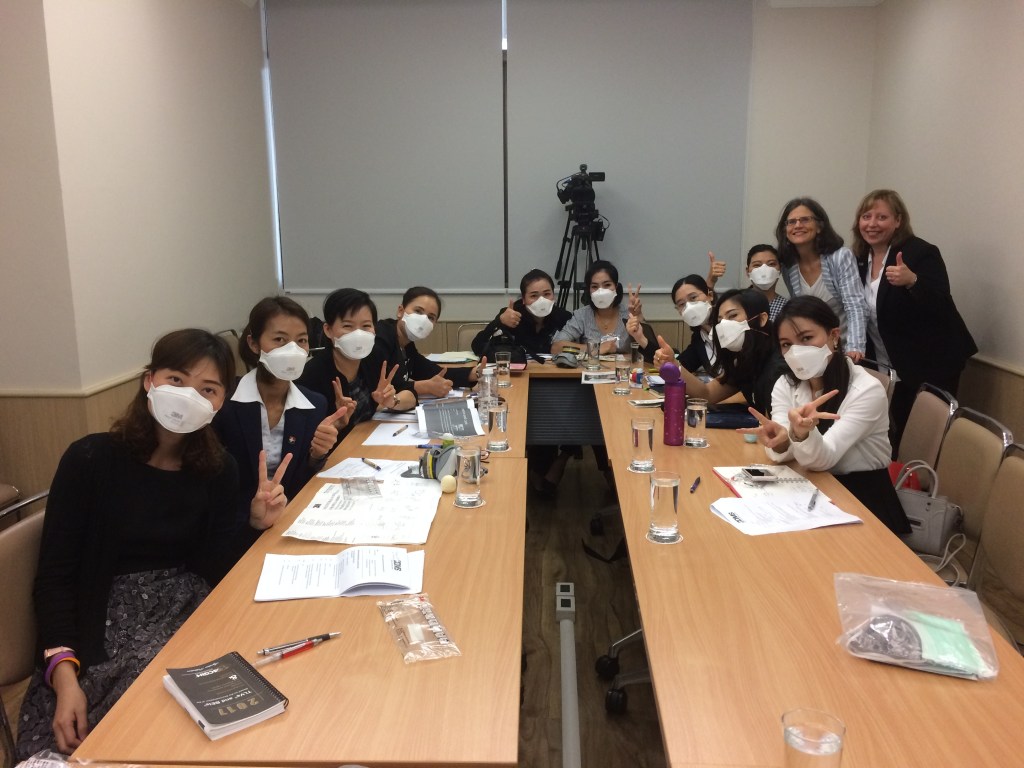
Another top of the list experience, three years running: teaching about industrial hygiene, respirators and well-being in Bangkok Thailand.
 Dede's Books and blog