Let me say upfront, I’m one of those. I follow the rules of the road and try to be polite as both cyclist and driver. For years I’ve felt a bit apologetic to drivers when cycling on streets that were narrow or curvy – as if I was cramping their style, slowing them down. I think most drivers are polite to cyclists and patient, even if frustrated. Yet, on a recent ride here in West Linn and Lake Oswego, two encounters made me rethink my apologies. The worst was the guy who honked loudly and yelled “Get on the f-ing bike lane we are spending taxes on!” as he sped past me SO FAST. (There wasn’t a bike lane, by the way.) I do everything I can to be safe and polite on the road. I ask drivers to do the same.
While mostly I don’t blog about cycling or bikes, I have posted several in the last few years. I even have a category devoted to them. Most of this has been about my e-biking experiences and including one popular blog (Kids and e-bikes). (If you are a parent or loved one of a kid with an e-bike, I implore you to know both the laws and risks of e-bikes.) As an aside, if I were Queen of the Universe, I’d limit access of the Class 2 e-bikes (the ones with throttles) to people with demonstrated health need. Just saying…
My best friends understand how my mind bubbles with ideas while I both ride and walk. While cycling yesterday (commuting to Multnomah Village for a meeting), I had an image of my mother on her bike. We surprised Mom with a bike for her 68th birthday. If you’ve read my memoir from From First Breath to Last or happened to know adventurous Patty, this won’t surprise you. Mom was nervous at first – it had been decades since she’d last ridden! My daughters and I cheered her on as she practiced briefly on the Rosemont Track (before we knew better). Quickly Mom re-experienced the joy of riding her bike. She was six years older than I am now, and yet I too know that feeling that surged through her: the two-wheeled freedom. A joy many of us can find again if we’re willing to change things up.
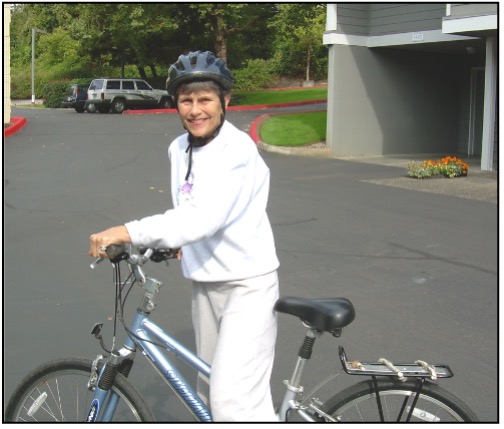
“Occasionally, Mom would jump on a bike and join us kids. But never Dad—not in those years. Dad had grown up riding a bike: it was by bike that he completed the early morning rounds of his first newspaper job, delivering the Oregonian to his Northwest Portland neighbors. And it was by bike that Dad learned, during one early morning delivery, how poorly brakes work on racing wheels in Willamette Heights’ steep hills, crashing into pavement and breaking his nose for the first time. Dad didn’t venture to ride a bicycle again until he turned seventy-two—long after our glory days in Wilsonville had fled. This time around, Dad, a man of routine, only reluctantly agreed to pedal again to keep up with his wife: we’d given Mom a bike for a birthday gift, and she was revving up. Dad insisted he would only join Portland’s bike frenzy if he could find a model similar to his childhood model Schwinn—never one to want the latest and greatest. He compromised on a yellow-and-black Giant three-speed.
Impulsive and animated, Dad immediately became an enthusiastic senior member of Portland’s avid biking community, especially on not-too-hot sunny days. Dad hated the heat. He liked best to pedal away from his river-view Sellwood neighborhood condo, his home of twenty late-life years and the last Portland neighborhood in which he would reside. He would ride along the Springwater Corridor and the Willamette River Esplanade, past the statue of his friend Mayor Vera Katz, across the Steel Bridge and the Willamette River. He rode to his post-retirement gigs, never interested in completely retiring, and he rode to meetings at the Oregon Maritime Museum—the steamer moored at Tom McCall Waterfront Park in downtown Portland, resurrected during his tenure as the museum’s president. Dad pedaled to the Alcoholics Anonymous meetings that helped him become the old man he was, in his old stomping grounds of Northwest Portland. And once, for reasons he didn’t know at the time, he fainted while riding on a sidewalk on Northwest 23rd Avenue. Dad didn’t carry a cell phone, neither did he want to bother anyone, so he picked himself up after hitting a parked car, and rode on home with blood dripping down his leg. Other days he and Mom bicycled together and reminisced about old Portland over cups of coffee in the newly fancy and expensive Northwest Pearl District. Enjoying their days. Not yet imagining a time when one of them might be left without the other.
Even as an old man, Dad was unmistakable: those muscled calves pedaling, a thick shock of white hair poking out from his helmet, and secret river memories flooding his pores. At eighty, after falling a couple of times, he permanently parked the yellow-and-black cruiser in a corner of his garage. Air slowly seeped out of the tires of his Giant, but Dad was never one to regret. Still, he pedaled in place: cottonwoods in his mind, music in his ears.
Chapter 4: Summer, My Music Man
My parents were fortunate with access to mostly safe bicycling outside the doors of their then Southeast Portland condo. Even then, they quickly learned how during certain times of the day, the Springwater Trail could feel a bit like an expressway. Yet, the reality of cycling today, especially in the suburban metro area, makes it virtually impossible to get very far without riding on shared roads. For some people that’s enough to avoid cycling, at least without throwing their bike on a car. The rest of us have tried to make it work. Six years ago I invested in an e-bike, so I could better commute to work at OHSU, pick up library books and groceries, and still live up off of Hidden Springs. It was one of the best investments I’ve ever made. And we have decided, for now, it’s more sustainable to drive our early 1990 model cars until they don’t drive any longer, rather than replace them, but to drive less. Because of that I push myself to do whatever commuting I can on my bike. I love the challenge and the adventure, and yes, I’m a lot like my mom in that respect. And yet, to do this we do have to ride less than ideal roads (parts of Stafford, Childs, Highway 43, etc.)
Finally, a bit about shared pathways. Cycle and pedestrian tracks, like the elaborate trail system near Portland’s South Waterfront, are expensive. I love them, no doubt. Yet they are not only expensive but take a long time to plan and construct. In the meantime, we have shared trails and opportunities, like in West Linn our newest trail along Salamo Road. (Yes, you can complain all you want about spending money on something you may think only a few will use. Time has proven that “if you build it, they will come.” It’s better for health and our environment. Period.) When I cycle on any shared trail that is not a true cycle track design, like the one that meanders along Terwilliger Boulevard and Tryon Creek Park, or along Lusher Farm and Rosemont, I’m particularly conscious of my speed. I also make sure pedestrians are aware of me before I pass them. (Sometimes if I’m particularly concerned about the frailty of folks or space, I even stop and get off.)
My spouse Russ made his splash into local politics when he was recruited to help put the Rosemont/Lusher trail in. It took a lot of time and work to design it, and to gather consensus, including from landowners. (Not long after he joined the West Linn Planning Commission followed by his election to both City Council and as Mayor). Although the intention from the start was for the trail to be shared by pedestrians and cyclists, a bureaucratic misunderstanding first led some to believe bikes were banned. Soon after, it was collectively recognized important to allow cyclists on the trail, given the dangerous Rosemont alternative. (And yes, speedy cyclists still ride down roads like Terwilliger and Rosemont so they can go fast.) Today, as I understand it, the short part of gravel trail switchbacks (just south of the upper parking lot) requires cyclists to walk their bikes. Most of us often cycle a short part of Rosemont on the road when going downhill to avoid it before moving back to the paved trail. All this to say – sharing the trail requires attention, kindness and a willingness to slow down.
Having ridden a bike for pleasure and to commute for most of my life, I offer a few insights.
- It takes all of us to make this work. Cars, pedestrians, runners, strollers and dogs and bikes.
- Kindness and etiquette is key. And a willingness to acknowledge when you make a mistake, share a signal that you are sorry rather than a crude gesture.
- We are often sharing roads and trails. It’s essential to both recognize and abide to the rules of both.
- Sadly, if there is impact, the car will always win. Being a smart cyclist (and pedestrian) means being aware and defensive all the time, even if it frustrates us.
- If you are driving – slow the heck down! Somedays, to me, it feels as though more cars drive faster than the speed limit than not. Protect our streets: it could be your kid or grandkid or friend who suddenly darts out to chase a soccer ball.
See you on the streets and trails! Thanks for being thoughtful, kind and safe. Got any other advice?
 Dede's Books and blog