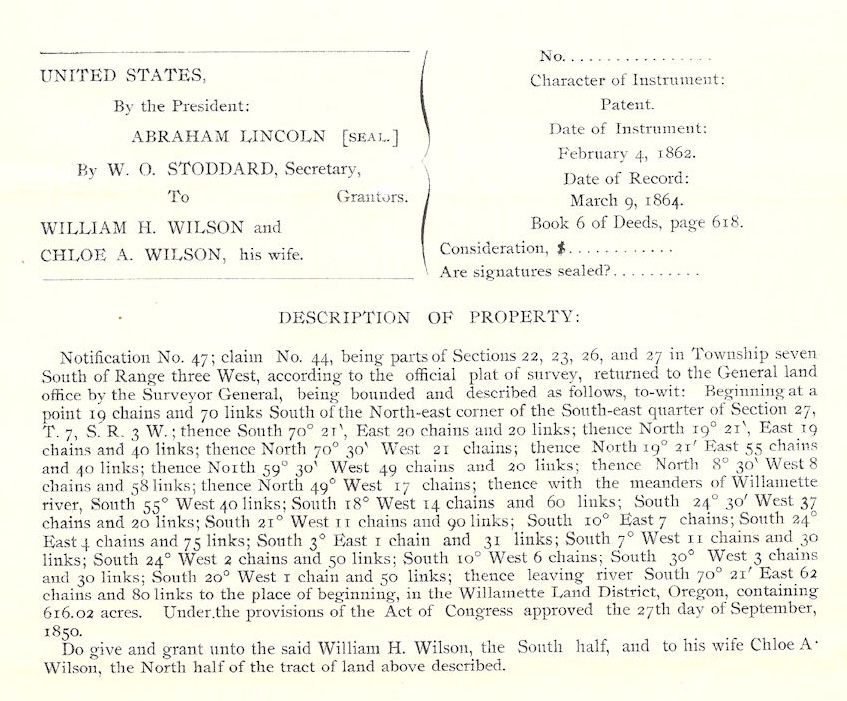
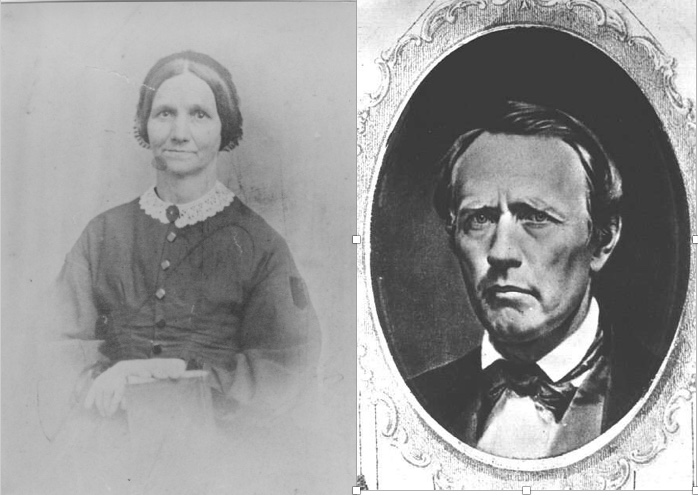
In 1864 my third great grandparents were sent the land deed for their Oregon property. All 640 acres, officially divided between Chloe Clark Willson and William Holden Willson at today’s Salem’s State Street. William died in 1856, and never saw the official document signed by President Abraham Lincoln. Although I’ve written about this here and there over the past decade, I hadn’t thought to do a simple internet search to see the document until last week. For whatever reason, the stories meant more to me than some of our official records.
Not quite ninety years later in 1950, my grandparents (including William and Chloe’s great grandson, Richard Gill Montgomery Sr.) purchased a few acres on the Long Beach Peninsula owning “to the dunes” with full ocean view. My parents were courting in those years of the purchase, and later all of us kids grew up knowing only this as the beach we visited. My grandfather and his grandfather (J.K.Gill), his parents and sister all spent time on the Peninsula. They too left behind stories about their steamboat trips from Portland to Megler, and the train ride up the peninsula. Yes, that was the TS Potter. (When you read my next book, A Map of Her Own, now you’ll know where my descriptions of that famous steamboat come from!)
Yes, my family has been privileged with land. And while my long ago ancestors on that side of the family originally came from Ireland (first Scotland) and England, they were here early enough to utilize their education and race to claim what seemed the thing to do then. However, we know the Indigenous Peoples first occupied these, as some would say stolen lands; the Chemeketa band of Kalapuya in today’s Salem, and the Chinook People of Washington’s Long Beach Peninsula.
Our family’s claim to that original land in Salem left us long ago, now visible as downtown Salem with the Capitol, and Willamette University. And rather than rewrite what I already published in my memoir My Music Man, I thought I’d share a few of those passages here. Oh, and if you haven’t yet read it (or even if you have), in a few weeks you can listen to it on Audible or Apple Books, and soon after (or depending on how long it takes me to figure out uploading) other non-Amazon or Apple owned platforms. All narrated by….me!
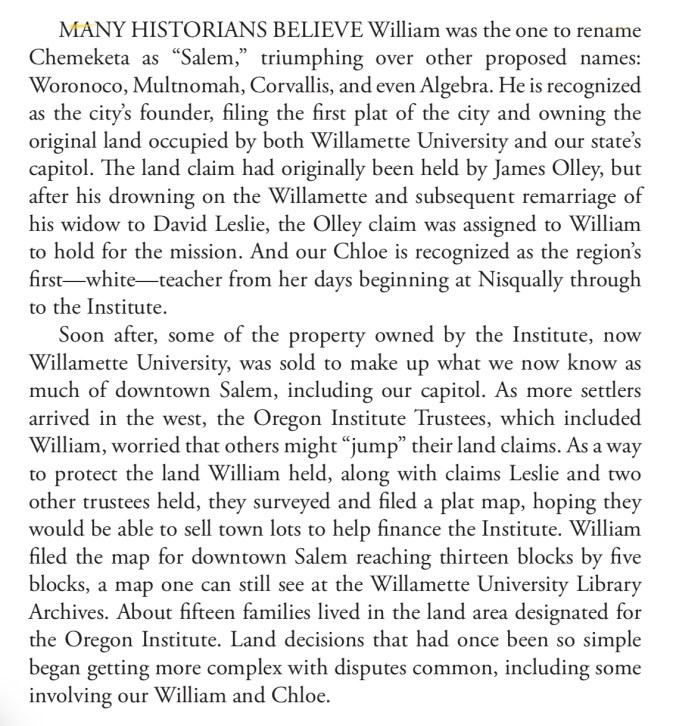
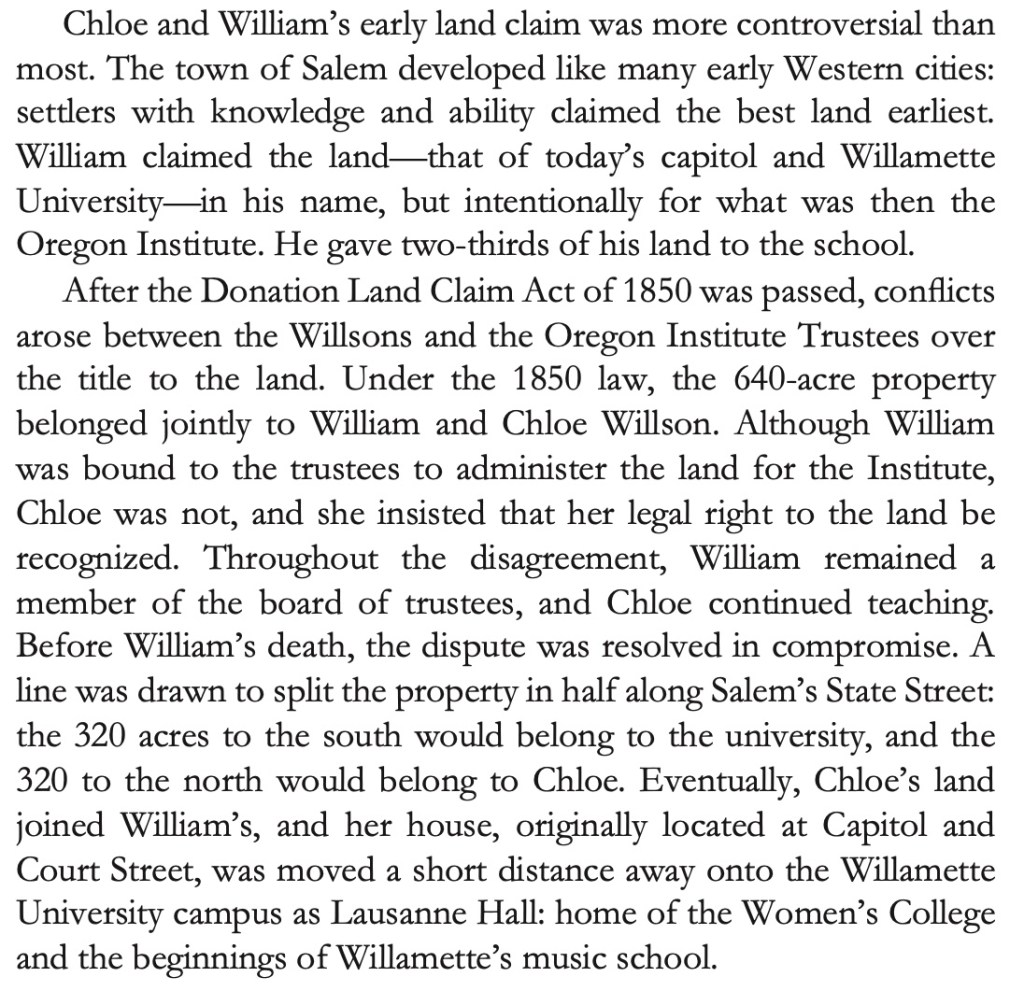
It was a unique enough story, that someone once wrote their dissertation on the contentious land claim split between William, as a trustee for Willamette University due to his role with the Jason Lee Missionaries, and Chloe, who insisted she never agreed to have her property deeded to Willamette. Many of us have found that interesting since she is recognized as the first teacher of Willamette University.
And for the very few of you who may have attended my reading at our Salem Capitol on Oregon’s 2019 Birthday, you may recall we could look out the window from the hearing room to this State Street dividing line. If you missed the talk, I thank the Oregon Capitol Foundation and Speaker’s Series for capturing it and sharing it on YouTube.


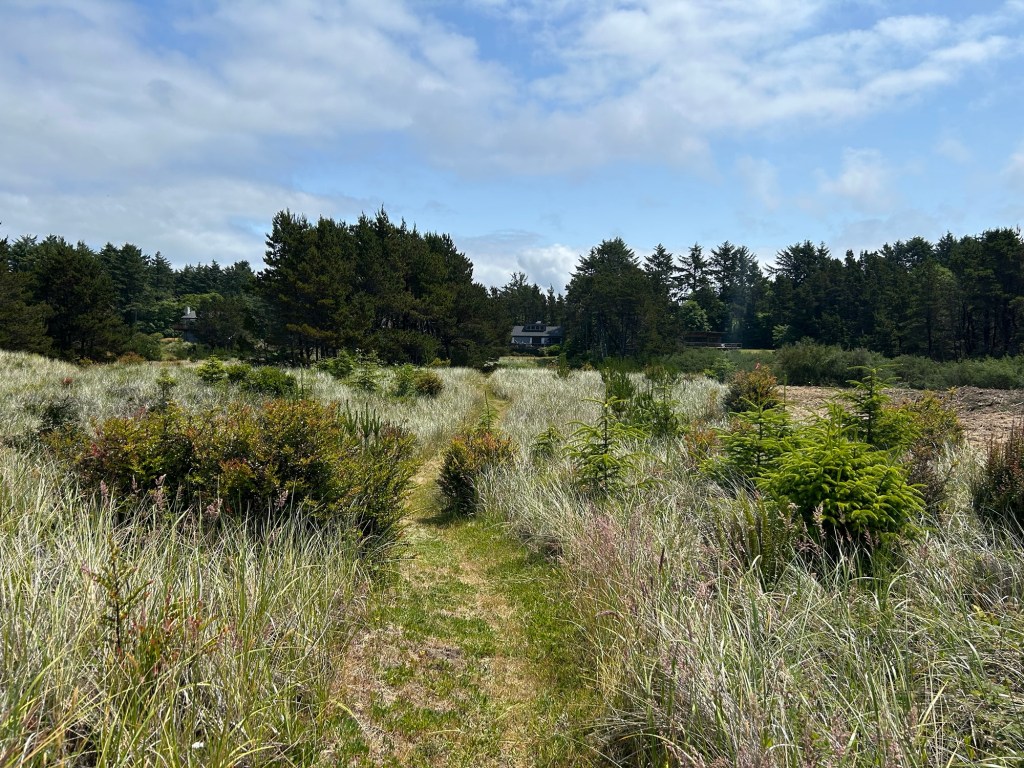
However, our Long Beach Peninsula land we believed to have increased over the years, with accretion of the ocean side of the peninsula due to silt deposited from the mouth of the Columbia River. Our kids, and now grandkids, can honestly claim they must walk further to the ocean than we did as kids. We grew up with the belief that our family “owned” the property to the dunes and ocean; which we did then. It was only recently we understood how lawsuits and the changing high tide mark has in fact shortened our legally owned property, with the County now owning a parcel between us and the dunes and ocean. Mostly, its an original stand of pine and spruce trees. Although some might like to cut them down to improve view of the ocean, we have long ago learned to embrace them and their provision of habitat for local deer, birds and other animals. Too, we do what we can to keep away the invasives of gorse and scotchbroom, especially invited as neighboring land is disturbed.
In reviewing Pacific County documents, we have learned that those of us property owners who bought our land in, say, 1950, were bounded to the West by the high water mark of 1889. What we didn’t know until last year was this:

“Unfortunately, the upland owner in order to plat, build or otherwise improve his land was obligated to bring an action against the State to establish his western line so that the County might approve his plat and the lender be assured that improvements and buildings be within the ownership etc.” While the Seashore Conservation Line was evaluated (and adjusted) every ten years, any owners who did not bring an action against the state to officially change the plat found their land unchanged. There were multiple legal cases in the 1960s and 1970s, and I suspect we just assumed we were covered in whatever changes occurred. Or maybe my parents didn’t know or think about it. Regardless, we own to the original 1889 high water mark, and neighbors directly to our south who have not owned their property as long as us, own a tract nearly to the now existing dunes. We too know, that “the big one” is likely to create a tsunami some day (tomorrow or in another decade or century) to wash away any existing peninsula land.
Not fair? Well, honestly, most of land owning in the west hasn’t been particularly fair, wouldn’t you say? For lots of reasons. Before, now and probably into the future. For now we take a deep breath, enjoy what we can, and try to help change those things that could be better.
 Dede's Books and blog