
Yes, I hear a few of you thinking: Didn’t she just say she’s retired? Yeah, yeah. It’s just that I do always hope to give back. And as evidence in my sharing this piece, though it might be contrary to what some believe, I too can’t turn my brain off. After catching up with a colleague over coffee last week, the words were churning over things I’ve been thinking about for what feels like forever. I’d be lying if I didn’t also say watching loved ones working in mental health, health care and education increases my angst.
I have been one of the biggest proponents of the NIOSH (National Institute of Occupational Safety and Health) Total Worker Health Approach for organizations, even since its beginnings were first captured in the 2005 Work Life Initiative. Beginning in 2011, as it was officially named Total Worker Health (TWH), I have supported the concept both through education and attempted implementation. Do I still believe in it? Yes, perhaps in a perfect world. But today’s workplace is far from perfect.
It is fair to say, those who advocate a TWH Approach acknowledge that it is a continuing process, with “real world” organizations perhaps never attaining completion of the ideal model. So yes, my friends, I still agree with that. What’s clearer to me and maybe unfair as I sit in mostly my retirement armchair, is the realization as to how most organizations aren’t doing the basic groundwork. Even those who have talked about or planned to. Perhaps it’s more about how removed our society is of work structure that best lends itself to this idealized Total Worker Health approach for all of its employees. I’m willing to believe that for a very small number of especially small, independent (not reliant on outside approvals, grants, economic good fortune) organizations, perhaps. I’m willing to say, for one, Apollo Mechanical, may have come close to the mark. It’s tough for me – though I don’t know everything – to come up with too many other examples.
I’ve been in the game long enough to remember back when a few of us helped develop The Fundamentals of Total Worker Health Approaches: Essential Elements for Advancing Worker Safety, Health, and Well-Being. Some of us used it as our primary teaching aid in continuing education classes and sessions with those in the occupational safety and health field. Thinking about it now makes me remember pushback of NIOSH and its developers over the diagram below.
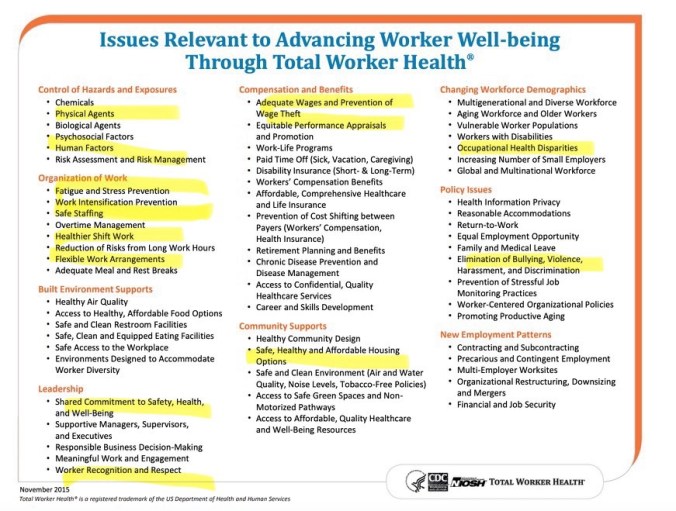
I remember as this document and diagram were rolled out, there were some who felt this was too comprehensive. “We can’t take on all of this!” Others felt it might detract from what they believed, such as not wanting to lose the focus on the importance of traditional safe and health risks. Soon after, those from organizational psychology helped folks understand how important psycho-social safety is to feeling safe at work. To both those things I say, yes, I get it. Back then I did understand to a degree: It was too big! So take on a small piece, a part, start with something that is working, baby steps. We said it all. But, I’m sad to say, I don’t think “baby steps” will ever get us there or to this ideal. I tend to be an optimist, often even too much so. But thinking about much of our work today? For example, simply improving supervisors through training or offering mental health support and even improving on the job safety ain’t gonna cut it. Yes, it will make moments better and certain days better. But it will not take away so many negatives
Healthcare is a prime example today. Sure, some folks might have benefits, even good pay – but their shifts are too long and often unsupporting of their own health. Or they either don’t have or can’t use sick or vacation time because there’s nobody there to pick up the pieces. Look at what people are facing in education and social services: funding cuts, short staffing, pay below the cost of housing. A decade ago, some folks said – we can’t do all that, we need to hone in on what is working or where opportunities exist. Until we can create systems in workplaces that create good, fairly compensated work; all the other stuff we’re doing is icing. Yes, supportive supervision might make us feel better and it might help us in dealing with some of our challenges. It might keep us feeling satisfied about what we’re doing. And yet if the organization itself doesn’t do all those other very difficult things it’s going to all be short-lived or at some point, something will break it for one person or for many. Yes, creating benefits that provide vacation and time off, that provide mental health support and dental care and therapy – essential. But if your healthcare coverage or useage costs so much that folks don’t use it, they can’t find a provider or get on a schedule, or if you’re holding down two or three jobs with no time, or your workplace is short staffed: none of those benefits make a difference. For workers who are well paid, unreasonable stress and demands, long shifts and too many work hours will detract from true well-being, especially over time, not to mention the increased risks to safety. If I’m being discriminated against or treated poorly I expect I may never be advanced fairly and my mental health and sleep will suffer. Whew. Do we say none of this matters? No, but I think we need to be realistic and honest about all of it.
What does all this mean? Not that I’ve given up on the TWH model. Just that I’m plenty more realistic. As they say, “let’s call a spade a spade.” We cannot truly make our work experiences what is called for in the TWH concept without clearly accepting and doing something about the work lives most folks have; and maybe even how society impacts us. And sorry to be a spoiler, but this ain’t happening anytime soon. Do we give up? Hopefully not. Do we stop taking the baby steps? No. But let’s be real about what we are gaining, and how much we are not improving. I’ll just say, the great thing about having my own blog is nobody has to agree with me. And honestly, I’d love to see you prove me wrong! My friends in the occupational health, safety and well-being world? What say you?
Oh and if you’re heading to the Northwest Occupational Health Conference next week in Bremerton and notice my name as the Keynote Speaker? Please don’t sleep in (unless you just worked too many long shifts and honestly, it might be healthier for you). I promise not to have us drowning in sorrow and in fact hope you will find it honest but uplifting. See you then!
Oh, and I do write books. Check them out.
 Dede's Books and blog