
The Portland Public Auditorium in downtown Portland, Oregon circa 1918, viewed from the west, across the intersection of SW 3rd & Market. Completed in 1917, the building was heavily rebuilt in 1967–68, when it was known as the Civic Auditorium, and currently is known as Keller Auditorium. Unknown author – Carey, Charles Henry. (1922). History of Oregon, p. 835. Pioneer Historical Publishing Co. Credit: Wikipedia.
Note: thanks to my friend who pointed out my ignorant use of a slang term. I apologize to anyone who was impacted or offended. I have since changed this blog title and URL.
Last week I was fortunate to attend a talk by favorite author Barbara Kingsolver at the Portland Keller Auditorium. Long one of my favorite authors, I was appreciative that I had read Demon Copperfield for this talk. Oh, what a sadly relevant topic highlighting our current societal challenges and disparities. Kingsolver is a powerful speaker and advocate. The Poisonwood Bible is likely my favorite of her books, and I’m reminded I am ripe to reread it all these years later. Probably followed again by Demon Copperfield. A couple of years ago I decided to retain (mostly) my favorite books and those of my favorite authors for rereading. (I try to give away others to friends and Little Libraries, though this is not a perfect system and stacks of books overflow my bookshelves and tables.) This same week I celebrate my 62nd birthday and threw myself a Crone party. Is it just me, is it my many years in one location, or those of family before me, that interrupts my brain patterns so often to connect stories from the old with the new?

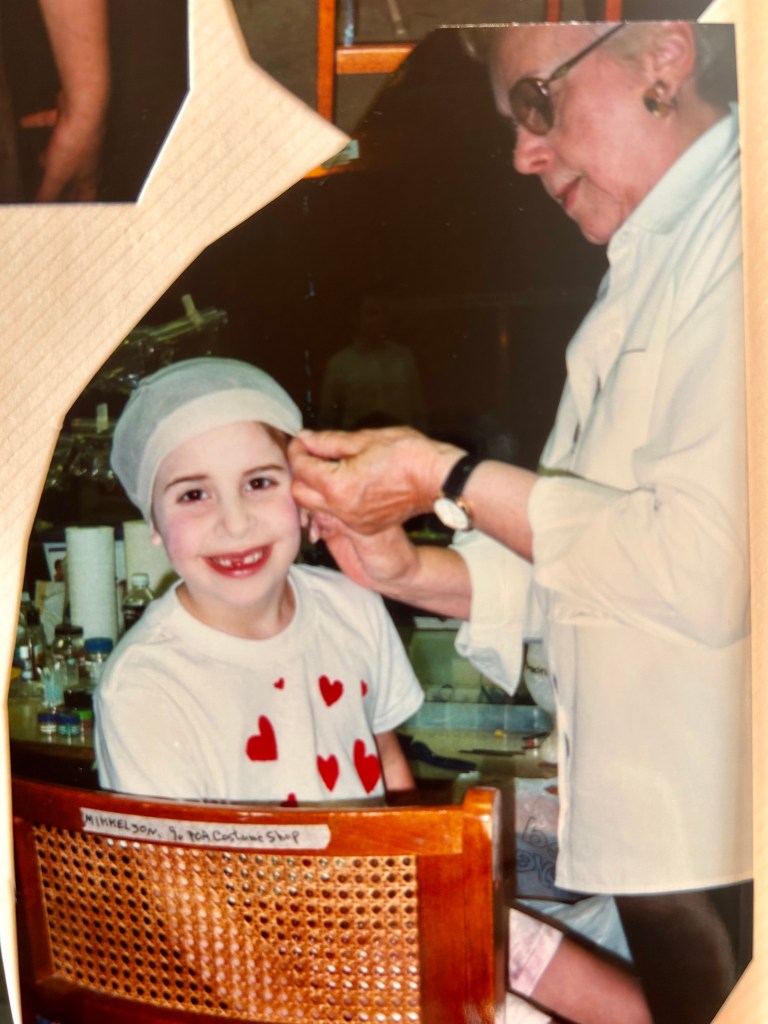
Not long ago, I saw a rerun of a Jerry Seinfeld show in which he is introduced to a wig stylist. As also happens to me often, I stopped following the story line briefly to remember when I had my first face-to-face encounter with a wig stylist, thanks to our youngest daughter. She was, in those days, what we referred to as a theater kid. When she was in the first grade she had the opportunity to audition to join a few kids to be (a small part) of a Portland Opera production of LaBelle Helene. This kid wanted to be onstage anywhere and anyplace, talking me into agreeing to let her participate or audition for things that sometimes came with substantial commutes. She was angry with me when she learned Emma Watson had been selected to be Hermione Granger in her then favorite book series and that she hadn’t even known about auditions. (“I can do an English accent,” she stated to me boldly. She was about 7 and Emma three years older, the age of our oldest.) In this production of LaBelle Hellene, held at the Keller Auditorium, she wore a wig. She stayed up late these nights when she was a first grader and complained about a few kids also cast as angels who were hellions for the child wrangler in the green room and bowels of the Keller. The wigs? Most of the kids absolutely hated them: itchy, constant reminders by the wrangler and wigger not to touch them. Being in the show? Emily loved each performance. All these years later she is an ICU critical care physician assistant to some of our sickest community members. As much as I worry about her own health and emotional stamina, I appreciate knowing this still sweet, smart (and sometimes stubborn) angel is taking care of people in need.
But back to the deeper history. I first learned about my great grandfather’s involvement (the same one who was the early footballer (see Early Portland and the flying pigskin)) when I was researching family during my writing of My Music Man. Another topic I wished I’d thought to discuss with his son, my grandfather Richard G. Montgomery, Sr. when he was still alive.
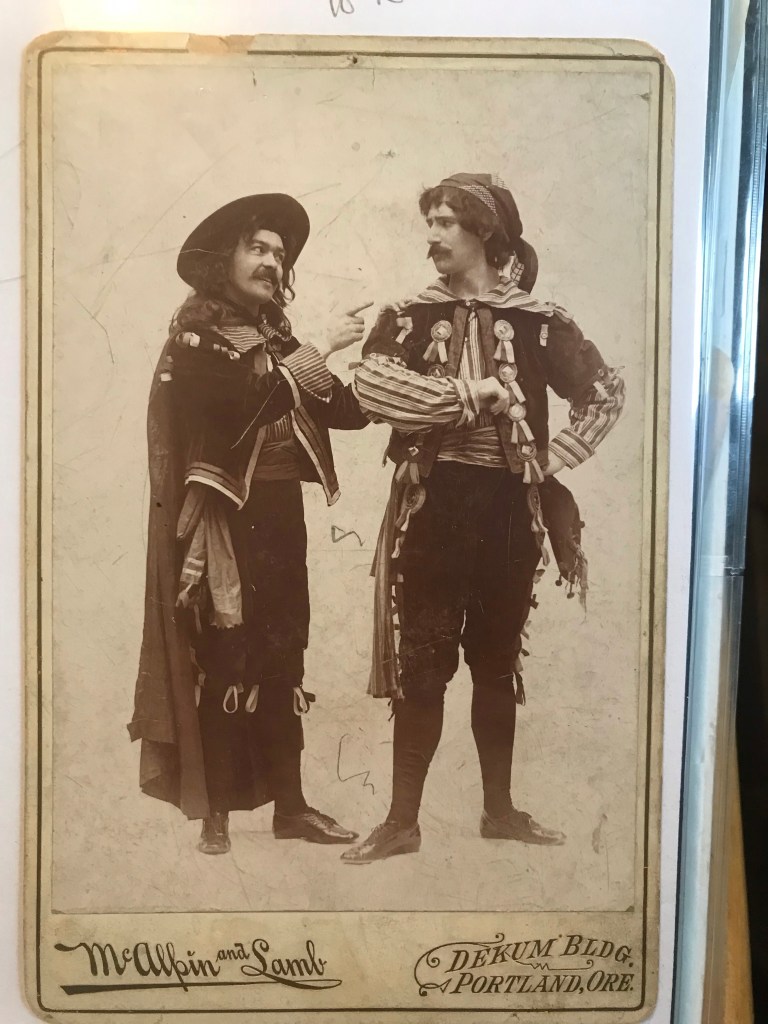
William Montgomery (right) in Portland Opera in 1898. Early Portland operas were held in Marquam’s Building 1,500 seat Orpheum Theater (later named Hippodrome and Marquam Grand Opera House) that eventually collapsed under the weight of its brick in 1912. Today we know this spot as Portland’s Pioneer Square.
“My great-grandfather William Andrew Montgomery had a most beautiful voice, and although he dabbled in opera, he was a founder and longtime member of the Apollo Club, a Portland men’s singing club. He also was an officer in the 1917 Portland Music Festival. This festival showcased a chorus of 250 voices and the Portland Symphony Orchestra to dedicate the new public auditorium, with profits from the event supporting the war relief effort. The auditorium: the same stage all Portland public high school graduates like me walked across to accept our high school diplomas sixty-some years later in the late 1970s. The same auditorium—though remodeled as today’s Keller
Chapter 5: Heart Strings from My Music Man
Auditorium—where I’d sit front-row with my own daughters, two decades after my own graduation, watching a production of Annie. “
MOMMY! REMEMBER WHEN I was on this stage?” Emily had whispered to me before the orchestra began the overture in this modern-day auditorium that swallowed small children into its darkened hollows. She smiled and wiggled in anticipation of the show, delighted that I had forked out entirely too much money for front row seats. I was relieved as I looked at my youngest daughter—she needed no reminders about proper theater etiquette. I smiled at the memory of her onstage just two years prior as one of a handful of kids donning blonde wigs and white wings to play impish angels in Portland Opera’s first international collaboration of La Belle Hélène in 2001. Set on this same stage. Capitalizing on opportunities for kids that I had merely dreamed about.
Yes, this ever changing and evolving auditorium. Used for so many community events. Not only was my own high school commencement held there, but I saw multiple performances from the Messiah to Oregon Children’s Theater to a Neil Young Concert, to mention a few. I am grateful we can still, at least to some degree, support our arts and work to be more inclusive of both performers and attendees. Just last month I read about the newest update proposal to expand this building, add more restrooms, close down the street between the auditorium and fountain (yay!). Certainly this will include upgrading much within the auditorium itself and in fact adding solar panels. Yes, change is everywhere. While we are worried and saddened by not so positive changes in this city so many of us love, and continue to hope and work for positive change, I am inspired that our community supports and updates fixtures that bring us together. That allow us to dream, create and share with each other.
 Dede's Books and blog

Great post! I’m newish to Portland and have only memories of a decade past at the Keller, but each trip there is amidst excitement of an event! It is so neat to see a photo of the building from 1918. I was lucky enough to raise my own child nearby, with trips to the Keller whenever we could save up enough to afford it. I read about the plans to close the street and open up the front all the way to the fountain, which I think is a brilliant plan, and I can’t believe it wasn’t done sooner. The entire plaza will fill with people, don’t you think?
LikeLiked by 1 person
Another fun read. Thx.
Hugs to you. 🤗
Sent from my iPhone
LikeLike
Thanks Dede, I always find your writing so warm and calming; so human in the best of ways. Happy fall,
Mike
LikeLiked by 1 person
Thank you, Mike, that means a lot to me. And in this post, I reminded how much we shared the “theater kid”thing together.
LikeLike