A few years ago when at our family cabin in Ocean Park, dear neighbor Sandy dropped by, gifting us a copy of the Coast Weekend with an article about my then new book Humanity’s Grace. While I had seen the article online, I had not yet realized the news source was a printed weekly magazine. That first interview with journalist Patrick Webb had been delightful, as if we were long lost friends.
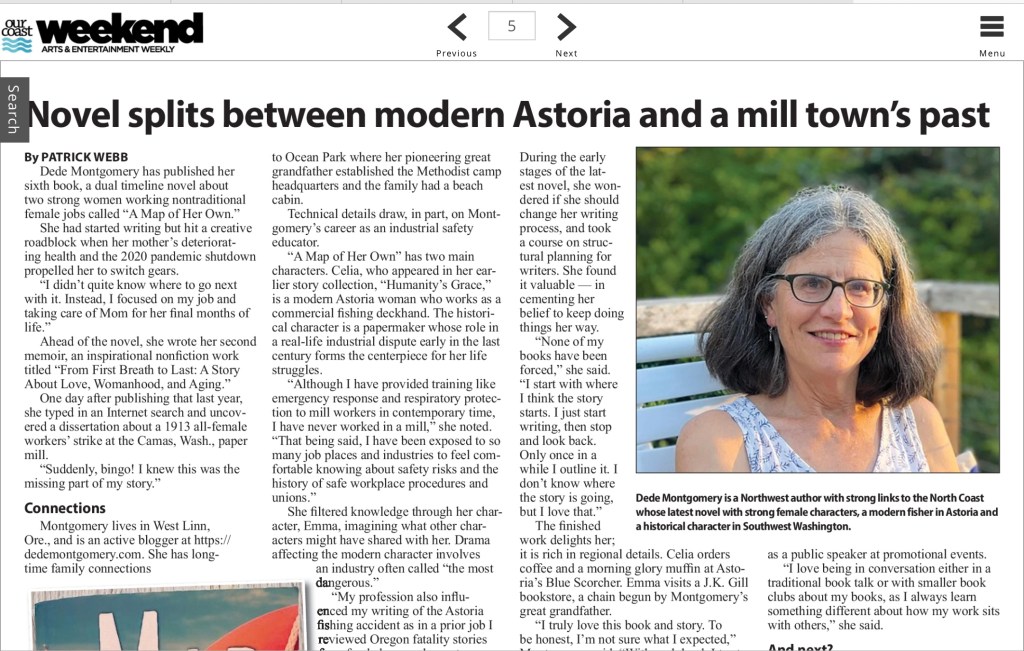
This time around I’m not quite so green. Too, I knew my phone call with Webb might be longer than shorter when he interviewed me for A Map of Her Own. That piece was printed in this week’s issue of the Coast Weekend. Unlike some who have written informational pieces about my books for news sources, Webb had read my entire book. What fun that interview was!
So much of what happens to me with my writing circles back to my own life experiences and connections, or that of my family. A very few of those who might have read my first book, My Music Man, may remember this story. For after all, it was Dad’s job offer in 1972 that initiated our family’s move from Wilsonville’s Montgomery Way first to LaGrande, and a few years later back to Portland.

So instead, Dad learned about Eastern Oregon, before returning to his roots and renewing his love and storytelling about the Columbia River for the Port of Portland. And on this morning, as I read this article published by the Astorian’s sister publication, I hear Dad. “That’s really something, Deeder.”
Learn more about A Map of Her Own on its webpage, including why I wrote it, editorial reviews, and where you can find it. And if you have not yet My Music Man, you might check out my recently released audiobook with my narration.
 Dede's Books and blog
Chapter 27 of A Map on Her Own by Dede Montgomery opened something in me. The scene between Celia and her grandmother felt more like a memory with my own abuelita (grandma). Their exchange echoed the quiet, intergenerational conversations I carry with me about origin, displacement, and what is lost when survival requires leaving. In that moment, I was both Emma and Celia: a woman shaped by migration, trying to understand her Indigenous roots not as history, but as something alive and unfinished.
I left Bolivia and traveled nearly 4,000 miles to Chicago, carrying inherited silences, unanswered questions, and the unspoken belief that moving forward meant moving away. I built a life there, but after twenty-four years, I felt the familiar restlessness return. I moved another 2,000 miles west to Portland, unable to fully explain why. I only knew that staying was not an option. I told myself it was for work, for change, for air and space, but beneath that was a quieter question: what was I looking for?
In the forests of towering redwoods, beside cold waterfalls, and in the presence of Mount Hood on a clear day, I felt something ancient stir. The land didn’t belong to me, yet it recognized me. It asked nothing, only that I slow down and listen. What I was searching for was not a place, but a reconnection, a sense of belonging…
_Spanish_
El capítulo 27 de A Map on Her Own de Dede Montgomery abrió algo en mí. La escena entre Celia y su abuela se sintió más como un recuerdo con mi propia abuelita. Su intercambio resonó con las conversaciones silenciosas e intergeneracionales que llevo conmigo: sobre el origen, el desplazamiento y lo que se pierde cuando la supervivencia exige partir. En ese momento, yo era tanto Emma como Celia: una mujer moldeada por la migración, tratando de comprender sus raíces indígenas no como historia, sino como algo vivo e inconcluso.
Dejé Bolivia y viajé casi 4,000 millas hasta Chicago, cargando recuerdos, preguntas sin respuesta y creer encontrar una vida mejor. Construí una vida allí, pero después de veinticuatro años sentí regresar la inquietud familiar. Me mudé otras 2,000 millas hacia el oeste, hasta Portland, sin poder explicar del todo por qué. Solo sabía que quedarme no era una opción. Me dije que era por trabajo, por cambio, por aire puro y espacio, pero debajo de eso había una pregunta más silenciosa: ¿qué estaba buscando?
En los bosques de imponentes secuoyas, junto a cascadas frías y en la presencia del monte Hood en un día despejado, sentí agitarse algo antiguo. La tierra no me pertenecía, pero me reconocía. No pedía nada, solo que me detuviera y escuchara. Lo que estaba buscando no era un lugar, sino una reconexión, un sentido de pertenencia…
LikeLike