I’m certain it is because of Dad’s love affair with our Willamette and Columbia Rivers past and present, that I too feel tied to Oregon’s river highway stories, and those that happened at their banks. Perhaps, more than Dad, I am aware of the environmental and cultural leftovers from some of those bygone eras. It is my own career in safety that has emotionally bound me specifically to Tradesworkers of today, both their importance to our livelihoods and the challenges they face. One of my favorite organizations is Oregon Tradeswomen, an advocate for women moving the trades, creating Pathways to Success, and leading efforts to instill Respect, Inclusion, Safety and Equity in the Construction Trades.

It was my interest in early Oregon Shipyards and my contemporary work with friends from NECA IBEW Electrical Training Center that made it natural for me to create characters in Beyond the Ripples, Amelia’s grandfathers, who worked in the shipyards as electricians. I knew that in segregated Portland, the early shipyard industry was a place two men of different races might become friends. I was able to trade notes with a historian I found through my IBEW contacts to ensure that the way I imagined these two characters to meet and work was accurate.

Photo Credit: Ray Atkeson via Oregon History Project. “During World War II, up to 125,000 people worked in around-the-clock shifts at shipyards in Portland and Vancouver, Washington. This photograph shows nightshift workers at the Oregon Shipbuilding Corporation (OSC), located in Portland’s St. Johns neighborhood.”
Thirty years ago, my dad requested my Aunt Dorothy (Dodie), one of Mom’s five sisters, to share memories of her years working in the shipyards. As I write my next book, I’m nearly overwhelmed by the additional stories and content I find in what Mom left behind. Our Aunt Dodie was not only one of two namesakes for my given name (Dorothy), but the sister Mom attributes to learning how to be a good mother. Kind, patient, inquisitive, and allowing kids to experience life. Mom wrote about how she remembered this older sister heading out for her summer job in the shipyards, and being wowed by her courage. She added Dorothy’s shipyard story as an appendix to her lengthy memoir. I’m not sure what Dad may have done with it all those years ago, but I imagine he may have referred to it in one of the Shipping News columns he wrote post retirement. Her introduction to the story below included her caveat that she didn’t know how to “write in sound bites.”
Here is my Aunt Dorothy’s Shipyard story.
“March 2, 2002
It’s been almost sixty years since I worked at St. Johns shipyard. My job at the shipyards happened because of a search to make “big” money for college. When I finished high school in June, 1942, I attended a vocational training course for machinists at Benson High. (I was shocked to discover I had no aptitude for that.) This led to a job at St. Johns shipyard in the electrical shop next to the ways where the ships were built. I was assigned to a small crew as an apprentice electrician, and started work in August. The small crew was mostly older men who treated me like a kid sister.
This crew’s responsibility was to provide temporary lighting for each ship as it went up. The job started when the keel was laid. The crew set out electrical boxes on the keel. The boxes were attached with heavy cables to high voltage boxes at the top of the scaffolding The connections were made when the power was off, but even so I was scared to death when I had to make the connections.
Drop cords, temporary lighting, and electrical equipment were plugged in to the electrical boxes. The boxes and lighting were continually moved and changed as the ship went up and became compartmentalized. The crew’s job was finished when the top deck was complete and the unfinished ship launched. The ship was then towed to the docks for completion which included installing the superstructures, finishing all the interiors and exteriors (wiring, plumbing, equipment).
I worked on the graveyard shift to earn the extra 10% differential. My initial pay might have been $.95 an hour for a 48 hour week. (I don’t know if we received overtime pay for the last eight hours.) This was much more than the $.60 an hour my girl friends in the office received. The work was miserable because much of it was outside in all kinds of weather and because the steel ship was grounded, primarily for the riveters. Electrical shocks from broken wires, bad connections, etc. were a daily occurrence.
I joined the union, attended classes at Union Hall in downtown Portland and within a few months became a Journeyman Electrician.
One year later in August 1943 I quit my job and started college. Thanks to the union I was able to return to work at St. Johns the summer of 1944. That fall the workers were assigned a seven day work week for a couple of months in order to increase production to a goal to launch one ship a week. I couldn’t resist the money (double time for the seventh day) so worked until the end of the year. The summer of 1945 the union found me a job at a different shipyard (Willamette Iron and Steel Works
next to the Ross Island bridge).
Working in the shipyards was my first exposure to a blue collar working society. Their interests and sometimes language was new to me. One of my first shocks was to discover that some of the men goofed off. (There were crap games in hideouts, men sleeping on the job, men stealing things) That first year seemed to last forever.
Gil (her husband) worked at Lockheed in Burbank in 1942 and was interested to compare my shipyard pay with his as a general assemblyman at $.75 an hour.”
While this was temporary work for my Aunt Dodie, I know the impression it made on my mom as she watched this sister who was her idol, illustrate for her that, yes, women could do anything they put their minds to. And I thank both of them for leaving these stories behind.
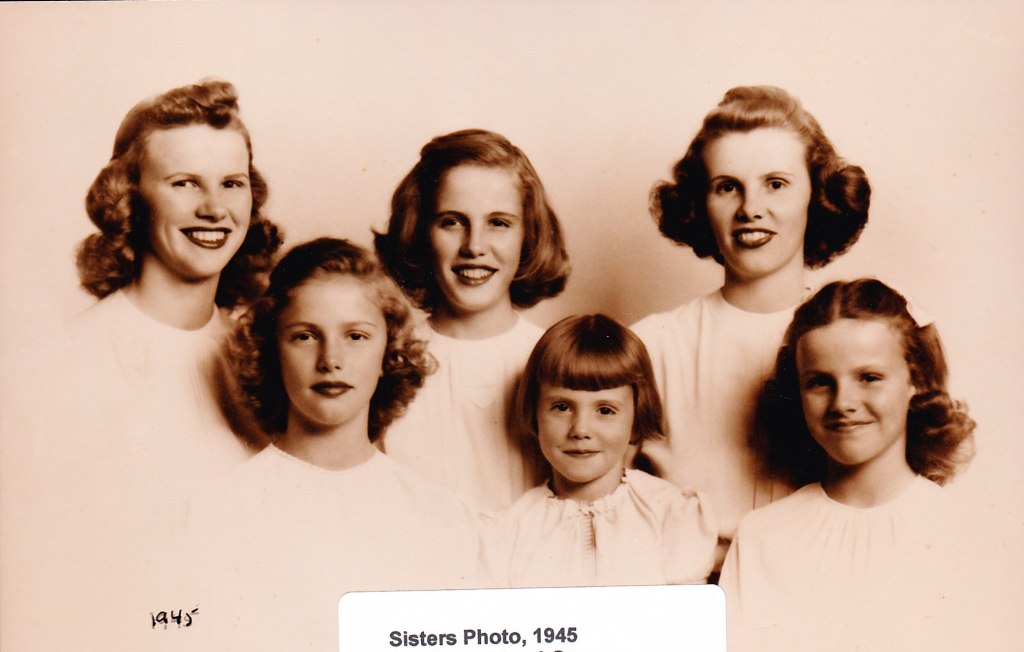
Although I don’t have a photo of Dodie during her summer work, this photo captures their spirits at the time. Top row: Dorothy, Marge, Barbara. Bottom row: Audrey, Miriam, Patty. Mom was second youngest, and all six Daum sisters attended Portland’s Jefferson High.
Check out my books, including Beyond the Ripples (2019) and A Map of Her Own (2025).
 Dede's Books and blog
I tried to leave a comment but was blocked at every turn ~ couldn’t even change my WordPress password! In a nutshell: I love it!
>
LikeLiked by 1 person
Sorry for the challenges but thanks for reading and making the effort!
LikeLike
This is a marvelous story. I’m so glad I read it. Is that your dad in the photo at the top?
LikeLiked by 1 person
Yes it is my dad. Thanks for following my blogs. Given your interest in history and writing I suspect you would enjoy my 2017 memoir, My Music Man. More at https://www.amazon.com/My-Music-Man-Dede-Montgomery/dp/1945805412/ and https://dedemontgomery.com/the-book-my-music-man/.
LikeLiked by 1 person
Pingback: We know it when we feel it | Dede's Books and blog
This piece beautifully captures the legacy and importance of skilled trades, particularly the role electricians have played in shaping critical infrastructure across generations. Stories like your Aunt Dorothy’s highlight why professionalism, training, and union support remain vital today. When homeowners search for an electrician near me, they are often looking for that same dedication to safety, craftsmanship, and reliability. Companies like Zoom Electric carry that tradition forward by delivering dependable electrical solutions rooted in experience and accountability. You can learn more about their work on Zoom Electric homepage.
LikeLike
Thanks Roman for finding my blog. Normally I would not support business advertising on this site. However, because of my long involvement and support of unions and electricians – not to mention the importance of such work – I am pleased to accept your comment. One thing you may not know is that I chose the electrician profession and NECA membership for two characters in my first novel, BEYOND THE RIPPLES. Also, although an industrial hygienist by training and not an electrician, I have spent many days supporting events at the NECA-IBEW Training Center. I hope your business stays busy and employees safe. Happy New Year.
LikeLike