Sometimes it feels nearly a lifetime ago that part of my job required me to blog weekly, usually about workplace safety or public health. Although I often enjoyed it, I really don’t miss it. Especially as I blogged on my own website simultaneously. A few times I knew I had to stay away from too much editorializing. In response, at least twice I blogged here (e.g, Worker safety, politics, the past; Hair and formaldehyde, power and health). That being said, although I have written about the joys of my own e-biking, I don’t tend to now blog about safety unless it has ties to well-being. So today, I deviate a bit in recognition of comments I shared with our City Council earlier this week, and today’s afternoon chat with kids. The best way to turn my brain off to recycled chatter I have learned, is to process it by writing. Bear with me, blog followers!
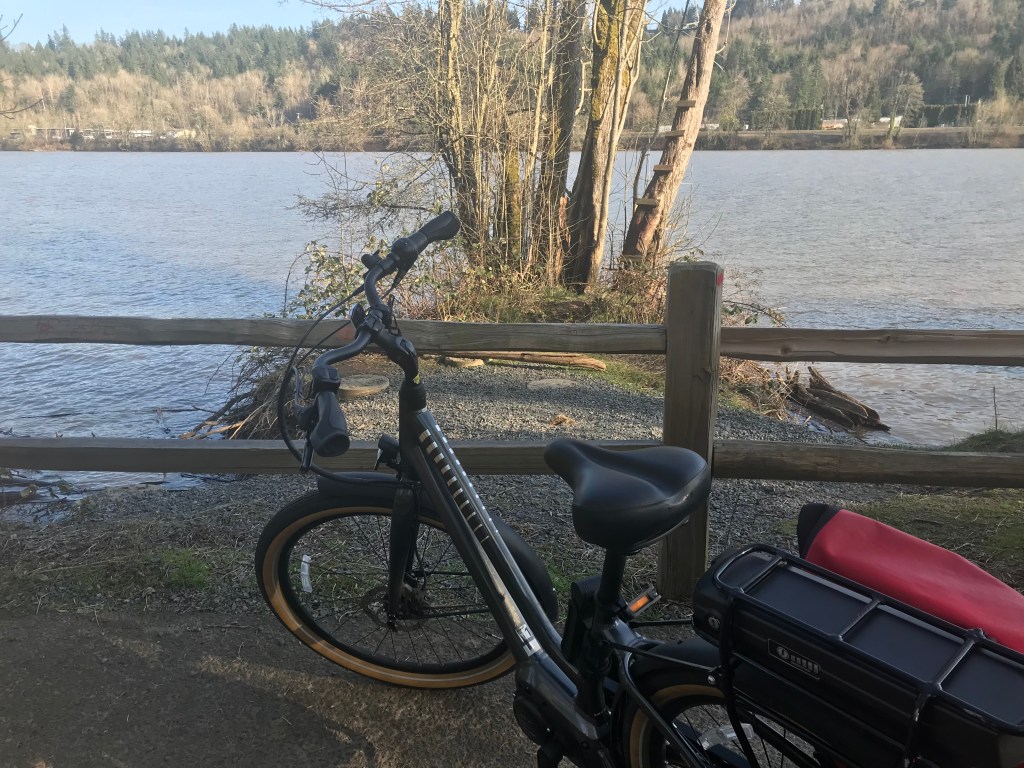
Yes, I am an e-biker. I’ve blogged before about why I’m grateful I invested in one, nearly 5 years ago. (See About that e-bike and E-bike: my two year review). I believe in them as a sustainable way to travel, exercise, commute and complete errands. They are particularly useful in hilly communities like mine. My concerns about kids and e-bikes relates to both my worries from a public health and safety standpoint, and my fears about further degrading some of the public’s dislike of bikes on the road (or in this case, sometimes our sidewalks). As I spoke to Council this week, and in a private conversation with our Chief of Police, I made it clear that I don’t have answers and I am not advocating that our community looks to citations: something that I don’t think any community intends to begin.
So what’s the problem? Oregon Law prohibits those under 16 from operating e-bikes (and e-scooters, for that matter.) Additionally, e-bikes are prohibited from being operated on sidewalks, although bike paths are acceptable with a few exceptions. I do a lot of walking in our local communities, and I can promise you that kids much younger than 16 are on e-bikes; and many of them are on sidewalks. Sometimes hordes of them. My friends at my favorite e-bike store shared with me that they always communicate about Oregon’s law when selling these. First, we might ask why the Oregon restrictions? Anyone who has ridden one before understands, first, that they can go fast! I have a Class 1 e-bike which provides battery assistance only when I pedal, and stops assisting at 20 mph. However, I’ve seen many Class 2 e-bikes that are equipped with throttles that boost power without pedaling. Class 3 e-bikes are equipped with a speedometer and get a boost up to 28 mph – these are not allowed on bike or multi-use trails.
Secondly, most advice shared by public health or emergency medicine professionals that I have seen says that e-bike riders should have a good understanding of road safety. Others like me who work professionally in workforce safety and health, understand there are other factors too that have influenced the setting of labor provisions for some more dangerous tasks or equipment operation for those under 18 (e.g., meat grinders, forklifts). Evidence tells us that those with less life or work experience can be at increased risk of injury, especially during an emergency or non-routine event. Although I don’t know, my guess is some of all of this went into the setting of the Oregon (and a few other states) rules. Certainly, fast bikes on sidewalks – while maybe making it safer for the rider by avoiding some confrontations with traffic – present additional risks to pedestrians. And those “gangs of kids on bikes” – which honestly, I LOVE seeing, can be a menace at higher speeds on restricted sidewalks shared with pedestrians or on roadways.
What’s the data tell us? Here’s from one published study: “Our study suggests that e-bike-related trauma may involve serious injuries and have typical injury patterns that resemble those seen in motorcycle-related injuries. Children are more likely to suffer head and face injuries because of their higher head to body ratio. We suggest that these injuries should therefore be triaged appropriately, preferably to a medical facility with proper trauma capabilities.”
Last month a Bend, Oregon 15 year-old died in a tragic e-bike traffic incident. More about this from Oregon Public Broadcasting. I have read about at least two others in other states, along with reports from at least one children’s hospital about increased emergency room visits riding e-bikes as compared to traditional bikes. I suspect the same might be for scooters. This all makes me so sad. And while we can be thrilled to get kids outside, getting some exercise and away from screens, I’m curious about what parents of these kids are thinking? Today I was at the grocery store and saw three kids (my guess is 12-13 years) of age unlocking their bikes, two that were e-bikes. I love kids of all ages (my daughter told me that some of the youngest kids in our neighborhood probably just think I’m an overgrown kid some days) and try to find a way to communicate with pre-teens and teens in a way that is respectful and interested in their viewpoints. As I asked today about their thoughts about what I feel is a conundrum, introducing myself as a fellow e-biker, I learned a few things. First, I wish I knew who their parents were as I would congratulate them on what I could tell about their parenting. All three told me e-bikes could be very dangerous as they go so fast. One told me about the Bend kid, that I had read about online the day before. They specifically pointed out that their parents had spent significant time going over the safety rules for riding, and the risks. All three told me they are not allowed to ride on sidewalks and that they have pretty good understanding of what roads they can ride safely on and how. This gave me great hope, and education is certainly part of the answer. It reminds me a bit of both the driver’s permit and the Oregon job permit that was in place when I was a teen.
I figured I’d write this blog as one way to get some other ideas and solutions. I do see e-bikes as great ways to help kids in hilly areas get around when they are mature enough to understand how to protect themselves and those around them. Riding to high school with all the books and gear required of many teens would be pretty tough on a traditional bike in neighborhoods full of steep hills. With those steep hills, though, comes additional risk for those newer to understanding how the bike works. E-bikes are expensive and a significant investment, meaning they aren’t available or even sensible for all young people. The privilege of riding one certainly should require the responsibilities of learning safe and respectful operation. Some municipalities and organizations have begun grant and reward programs to help fund them. Clearly, education seems an important part of this equation. Here’s what’s happening in Bend and some tips about e-bikes and kids from Children’s Hospital of Orange County.
What is or should or could be happening in our state and city? Feel free to share your thoughts.
Update: Since I published this blog, I was interviewed by the West Linn Tidings: West Linn Police encourage safety and awareness when it comes to e-bike usage in the community
See Dede’s other blogs. She writes books too. Check them out.
 Dede's Books and blog
I appreciate your education on this topic, as I know next to nothing about ebikes. I can see your concern that informs your post and coming from a background of safety I appreciate that this topic rises above others that you want to raise awareness of. That helps me put it into place with other safety concerns. I do not have a suggestion for a solution, and wonder if there isn’t one, other than what you hint at: more education, more awareness. My favourite things about this post are that you 1) have clearly developed an open-minded way to approach young people (so few adults respect kids in this way!), and 2) relayed a conversation with these kids that mirrors what I discover when I talk to young people. They are so aware and thoughtful, compared to what I recall being myself at their age. What is left to be done, when kids are this informed, this careful, this knowledgeable, this up to date (knowing about a recent death), and still get harmed? There is no way to protect our children 100%. There will certainly also be kids (and their careless parents) who are nowhere near this prepared or informed, and they are more likely to be the ones who get hurt. But there is no way to force education on parents who can’t or won’t learn. It is a tough one. I think your efforts to speak up about it are one of the most impactful contributions you can make. You are using your experience to talk to city leaders who have an impact, and they must appreciate it and I hope they use it. Thank you.
LikeLike
Just saw this article in the NYT today and thought of you. https://www.nytimes.com/2023/07/29/health/ebikes-safety-teens.html?smid=url-share
LikeLiked by 1 person
Pingback: An apologetic cyclist no more | Dede's Books and blog
Pingback: Navigating Youth Sports: Balancing Competition With Fun | Dede's Books and blog
Dede! Another e-bike story in NYT today. I guess I will always think of you now when the question of e-bike safety is discussed. 🙂
LikeLike
Yes, I saw it too! Such a new tech challenge e-bikes present. Thinking of you and thanks for reading along.
LikeLiked by 1 person